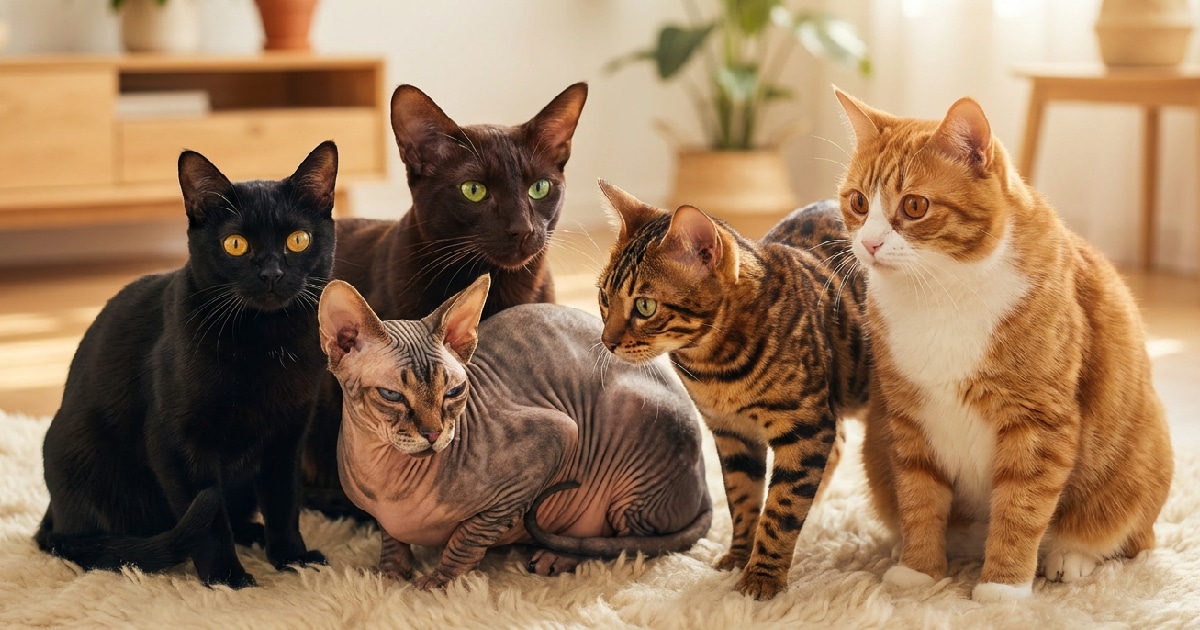
Whether it’s a blend of many breeds or a purebred, every cat has its own origin story. Some of those stories are fairly easy to guess, like the American Shorthair or the Scottish Fold, but others took a much more unexpected path to get where they are today. Take the Manx and its missing tail, or the Bombay with its golden eyes — do you know how either of those came to be? Test your knowledge and see how much you actually know about where these five well-loved cat breeds came from!
The Backstories of 5 Cat Breeds
1. Sphynx
The Sphynx holds the distinction of being the only cat breed to originate in Canada. With their tall ears and widely spaced eyes, they might resemble ancient Egyptian statues, but this breed actually traces back to a single hairless kitten born in Canada during the late 1960s. Breeders selectively bred that kitten’s line, eventually producing the hairless breed we recognize today. It took the dedication of a handful of committed Sphynx enthusiasts, working through careful selective breeding, to establish the breed we see now.
2. Bombay
Despite sharing its name with India’s capital city, this striking black cat breed actually got its start in the United States. Their glossy black coats and piercing yellow eyes give the Bombay that classic spooky look often associated with Halloween decorations. These eye-catching “mini panthers” aren’t just good-looking — they’re also clever and sociable, and they tend to shower their families with affection.
3. Havana Brown
Recognizable for their deep chocolate-brown coat and vivid green eyes, the elegant Havana Brown is a breed many cat lovers know on sight. Despite the name evoking Cuba’s capital, this breed actually originated in the United Kingdom, where it’s also sometimes called the Chestnut Brown, having emerged during the 1950s. Havana Browns crave companionship and won’t hesitate to make it known if they feel they’re being overlooked!
4. Bengal
Known for its playful antics and spirited personality, this spotted breed developed in the United States through hybrid breeding programs. Today’s Bengals are believed to descend from crossing a domestic cat with an Asian leopard cat. That exotic ancestry comes with an equally exotic price tag — buyers often pay thousands of dollars for these rosette-marked, acrobatic cats.
5. Manx
Aside from lacking a tail, this breed largely resembles a typical American tabby. It developed off the coast of the British Isles, on the small Isle of Man. Originally known as the Manks, this tailless cat resulted from a naturally occurring genetic mutation that leaves them without a tail from birth.
A Surprising Twist!
So how many of these origin stories were already familiar to you? Being the cat enthusiast you are, you probably already knew a good chunk of this. And if not, you’ve now added a little more feline trivia to your collection — which is always a win!