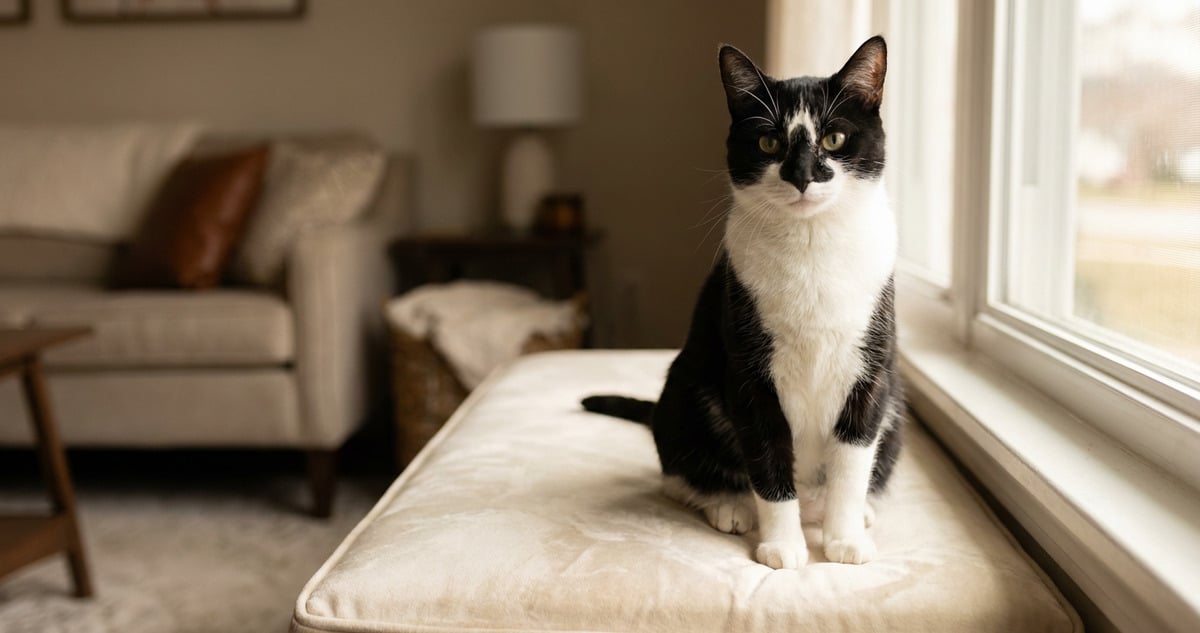
A tuxedo cat can walk into a room and command attention without any effort at all. That crisp black-and-white coat gives them a permanently dressed-up look that’s hard to overlook. But there’s much more to these cats than their sharp appearance.
Here’s something that catches a lot of people off guard: “tuxedo” isn’t a breed at all. It’s a coat pattern, and it turns up in dozens of unrelated breeds with completely different builds, personalities, and temperaments. Whether one already lives in your house or you’re considering bringing one home, here’s a closer look at what makes tuxedo cats so fascinating.
What Actually Qualifies a Cat as a “Tuxedo”?
The label comes straight from the coat itself. A tuxedo cat has a mostly black or dark coat with white patches across the chest, belly, paws, and sometimes the chin or face. Those white patches sit against the dark fur much like a white shirt peeks out from beneath a black jacket.
Black and white is the traditional combination, but the pattern isn’t restricted to those two shades. Gray-and-white cats can carry it too, and so can orange-and-white cats, even if some purists balk at calling those “tuxedos.” What actually defines the look is the contrast itself — a darker body paired with lighter markings concentrated toward the front.
No two tuxedo cats are marked identically. Some have markings so symmetrical they look hand-painted. Others end up with uneven blotches, ragged borders, or a white “mustache” that leaves them looking permanently startled. That unpredictability is a big part of their charm.
The Genetic Story Behind the Tuxedo Look
Geneticists classify tuxedo cats as piebald, or bi-colored. Their white patches trace back to the white spotting gene (called the S gene), which blocks pigment from forming in certain regions of the coat while the kitten is still developing in the womb. Exactly where those white patches land is largely a matter of chance, which is why littermates can end up looking nothing alike.
How much white shows up varies quite a bit. A mild dose of white spotting produces the familiar tuxedo appearance, with white restricted mainly to the chest and paws. A heavier dose creates cats that are mostly white with dark patches — a different pattern altogether, usually called “van” or “harlequin.”
Tuxedo Cat Quick Facts
- What it is: A bi-color (piebald) pattern, not a breed
- Genetic cause: The white spotting gene (S gene)
- Typical look: A black body with white on the chest, paws, and sometimes chin
- Sex distribution: Roughly even between males and females (unlike calico or tortoiseshell)
- Breeds that carry it: American Shorthair, British Shorthair, Maine Coon, Persian, Cornish Rex, Norwegian Forest Cat, and countless mixed breeds
Here’s an interesting genetic wrinkle: unlike calicos and tortoiseshells, the tuxedo pattern has nothing to do with sex chromosomes. Male and female tuxedo cats show up in roughly equal numbers. Calicos, by contrast, are almost always female because their three-color coat requires two X chromosomes — a restriction the tuxedo gene simply doesn’t share.
Which Breeds Show Up With Tuxedo Markings?
Because tuxedo describes a color pattern rather than a breed, it turns up across a surprisingly wide range of cats. No official breed standard requires the tuxedo look, yet plenty of breeds produce it regularly.
Breeds where you’re most likely to spot the pattern include:
- American Shorthair: among the most common tuxedo carriers
- British Shorthair: tuxedos here come with a stockier, rounder frame
- Maine Coon: tuxedo markings stand out dramatically on their large, fluffy frames
- Persian: pairs the breed’s flat-faced look with formal markings
- Cornish Rex: curly coats combined with tuxedo patterning make for a distinctive look
- Norwegian Forest Cat: large, fluffy tuxedos built to handle cold weather
- Scottish Fold: folded ears paired with tuxedo markings make for a memorable combination

Mixed-breed cats are likely the most common tuxedos out there. Visit almost any shelter and you’ll spot at least one black-and-white cat sporting that unmistakable formal pattern, waiting to be adopted.
Famous Tuxedo Cats Through the Years
Tuxedo cats have been winning people over for centuries. Several major historical figures kept them as companions — William Shakespeare owned tuxedo cats, and so did Beethoven and Sir Isaac Newton.
There seems to be something about that dapper black-and-white combination that appeals to brilliant minds.
Inside the White House, the Clinton family’s cat Socks turned into one of the most recognizable felines in American political history. Socks, a textbook tuxedo, called 1600 Pennsylvania Avenue home from 1993 to 2001 and reportedly received tens of thousands of letters from fans.
Tuxedo cats are all over pop culture too. Sylvester of Looney Tunes fame, with his black body and white face, might be the most instantly recognizable animated tuxedo cat of all time. Mr. Mistoffelees, the magical feline from Andrew Lloyd Webber’s “Cats,” is another well-known example.
Felix the Cat, among the earliest animated characters from the silent-film era, also wears the classic pattern.
Famous Tuxedo Cats You Might Know
- Socks Clinton: called the White House home from 1993 to 2001
- Sylvester: the Looney Tunes character forever chasing Tweety Bird
- Felix the Cat: one of film history’s earliest cartoon characters
- Mr. Mistoffelees: the magical tuxedo cat from the musical “Cats”
- Dr. Seuss’s Cat in the Hat: perhaps the most iconic fictional cat, sporting a tuxedo-style design
Is There Really Such a Thing as a “Tuxedo Personality”?
Cat lovers love pinning personality traits on coat colors — orange cats are goofy and friendly, black cats are mysterious, tuxedo cats are spirited or unusually affectionate. But how much of that actually holds up?
From a scientific standpoint, coat color by itself doesn’t shape personality. Temperament is shaped by breed genetics, early socialization, individual life experience, and environment. A tuxedo Maine Coon and a tuxedo Siamese mix will behave completely differently, because breed influence outweighs coat pattern by a wide margin.
That said, a 2015 study out of UC Davis found that owners consistently described calico and tortoiseshell cats as more aggressive than cats with other coat patterns, while solid-colored and tuxedo cats scored lower on those same aggression measures. The researchers noted that owner bias and expectations might be influencing those reports, but the pattern in the data held up statistically.
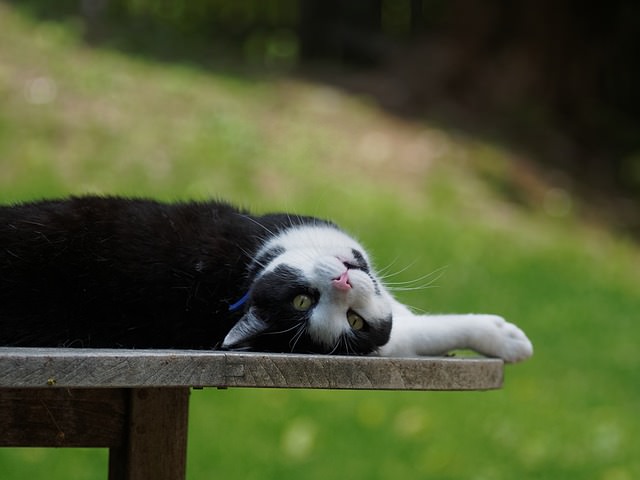
Where most tuxedo cat owners agree is that their cats have big personalities — vocal, confident, and social. Whether that’s truly connected to the genetics driving the tuxedo pattern, or simply a byproduct of how much attention these eye-catching cats attract from their owners, remains an unanswered question.
Tuxedo Cats and Shelter Life
Black-and-white cats, tuxedos included, can sometimes wait longer for adoption than cats with flashier coloring. This is sometimes labeled “black cat syndrome,” and while it mostly affects solid black cats, bi-color cats with heavy black markings aren’t entirely immune either.
There’s an upside, though: tuxedo cats tend to photograph more successfully than solid black cats, since the white patches give the camera something distinct to focus on. Shelters that put effort into quality adoption photos often see tuxedo cats with striking markings get adopted more quickly, since their unusual patterns catch people’s eyes online.
If adopting a tuxedo cat sounds appealing, start with your local shelter. They’re common in rescue populations, and there’s a good chance you’ll find one whose personality matches yours.
Health Notes for Tuxedo Cats
Because “tuxedo” describes a pattern rather than a breed, there’s no health condition tied specifically to the coloring itself. The white spotting gene responsible for the look doesn’t carry the same risks associated with the gene behind all-white coats (all-white cats, particularly blue-eyed ones, face a higher risk of deafness).
Whatever health risks your tuxedo cat faces will mostly come down to breed background, genetics, diet, and lifestyle. A tuxedo Persian deals with different concerns (breathing issues, kidney disease) than a tuxedo American Shorthair, which tends to be hardier with fewer breed-specific problems.
The usual preventive care still applies here: routine vet visits, vaccinations, dental care, good nutrition, and either indoor living or supervised time outside. None of that shifts based on coat color.
Grooming Tips for a Tuxedo Cat’s Coat
Tuxedo cats don’t require any grooming beyond what’s typical for their breed. Short-haired tuxedos — the more common variety — do fine with a weekly brushing to clear away loose fur and cut down on hairballs. Long-haired tuxedos, such as those descended from Maine Coon or Norwegian Forest Cat lines, need more frequent brushing to avoid matting.
White fur shows stains far more obviously than dark fur does. If your tuxedo cat has white paws, you may spot a yellowish tint near the nails or paw pads. That’s usually just residue from the litter box and wipes away easily with a damp cloth. Tear stains around the eyes can also stand out more against white facial fur.
A solid flea-prevention routine matters even more for cats with white patches, since flea dirt — those tiny black specks — is much easier to spot against white fur and can serve as an early warning sign of a flea problem.
Frequently Asked Questions
Are tuxedo cats considered rare?
Not even close. Tuxedo is among the most common coat patterns found in domestic cats, particularly in mixed breeds. You’ll find them in nearly every shelter.
Do tuxedo cats get along with other pets?
Coat color has nothing to do with how a cat handles living with other animals. Breed background, socialization, and individual temperament matter far more. Some tuxedo cats are highly social, while others would rather be the only pet in the house.
What’s the typical lifespan of a tuxedo cat?
Lifespan comes down to breed, not coat pattern. Most tuxedo cats kept indoors live somewhere between 12 and 18 years, in line with domestic cats generally. Mixed-breed tuxedos sometimes outlive purebreds thanks to greater genetic diversity.
Do tuxedo cats have to be black and white?
The traditional tuxedo is black and white, but the pattern can appear in other color combinations too. Gray and white, brown and white, and even orange and white cats can carry a tuxedo-style distribution of markings, though some enthusiasts insist the “tuxedo” label applies only to black and white.
Why do some tuxedo cats have white patches on their backs?
The white spotting gene doesn’t always stick to the “classic” tuxedo layout. White patches can sometimes show up on the back, sides, or legs in addition to the chest and paws. Because the gene’s expression varies so much, no two tuxedo cats end up looking exactly alike.
Can two tuxedo cats produce kittens that aren’t tuxedos?
Yes. Inheritance of the white spotting gene is complicated, and two tuxedo parents can still produce kittens with solid coats, different bi-color patterns, or the classic tuxedo look. Genetics tends to be predictable across large populations but far less so for any one litter.
Why Tuxedo Cats Continue to Win People Over
There’s something undeniably charming about a cat that looks dressed for a formal occasion around the clock. Tuxedo cats pair that visual appeal with the entire spectrum of feline personalities, and they show up in enough different breeds that nearly anyone can find one suited to their lifestyle.
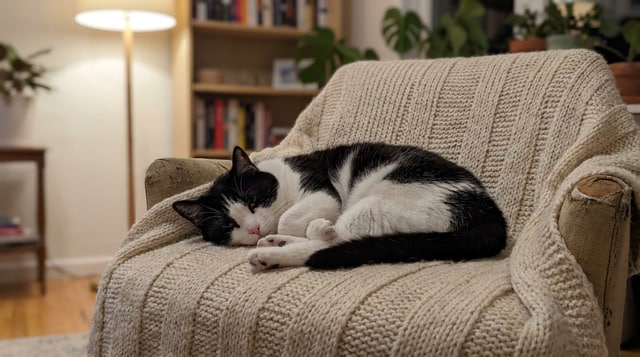
Whether it’s the history, the genetics, or simply the sight of one curled up on your couch that draws you in, tuxedo cats are worth getting to know. They’re common enough to make adoption easy, yet individual enough that no two are ever truly alike.
If you share your home with a tuxedo cat, you already understand. They don’t just wear the look. They own it completely.